COLLABORATIVE RESEARCH
For the Ministry of Internal Affairs I coached a team of experts from two government agencies (Vereniging Nederlandse Gemeenten and the Central Bureau of Statistics ) on a project aimed to answer this question: How can we help Dutch municipalities to be more data driven?

A shared research space
The end goal was to form shared policy and plans. VNG and CBS hadn't collaborated before, so my goal was to get everyone on the same page. By asking "for whom are we solving this problem, and what is their current data driven mindset and behaviour?" a neutral research space opened up where everyone could share their knowledge, and no-one was in the lead.
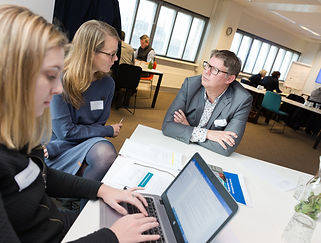
I organized a Research Sprint with four municipalities and got every VNG and CBS team member actively involved. It took time to organize, but the shared understanding of user needs that we built was extremely effective when it was time to make decisions. The approach created shared responsibility.

Sparking creativity
One of the challenges of co-creation is: How to get the creative juices flowing? For new ideas we need to be able to think freely and allow for imagination. For the data driven project I hired a Movement Coach to help get everyone out of their current mindset and get ready. She gave us some fun group challenges that sparked our creative brains and created a group feeling at the same time. This helps as well when it is time to make decisions.

Research materials
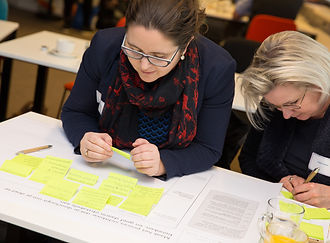
To get the most out of the workshop I created tailored research materials: interview structures to guide all interviewers, and canvases on which participants could plot their knowledge and issues. I also gave them homework assignments, as a way to prepare for the workshop, and to speed up the process. This approach led to shared curiosity and a form of co-research.

Not jumping to solutions
It takes professional skills to to prevent people from jumping to single solutions and to get them to generate as many as possible. And it also takes professional skills to then creatively work with those ideas, to create new connections, new views, new insights from them. For this project I mixed groups up between diverging and converging and I challenged them to pick up other people's ideas and take those further.

Sense making
Spending time analyzing and synthesizing ideas and insights: that's when new value can be created. This sense making can be most difficult to do with a group. It means diving in deep during, but also after the research, and keeping people motivated to postpone drawing final conclusions.
For this project we planned multiple days for analysis, and we also made sure that every idea was digitized to speed up the process.
Leading others through collaborative research and design activities helps me to practice the skills to lead change. It requires soft skills as well as listening, communication-, moderation-, facilitation-, and team-building skills. You need to be able to read people and to make them feel safe while you take them out of their comfort zone. At the same time you need to be able to rally and motivate people, and make them feel valued. Sessions can take turns that you weren't prepared for., so you also need to be flexible while keeping a strong focus on the core goal. Each session I lead is a great way to learn by doing.